
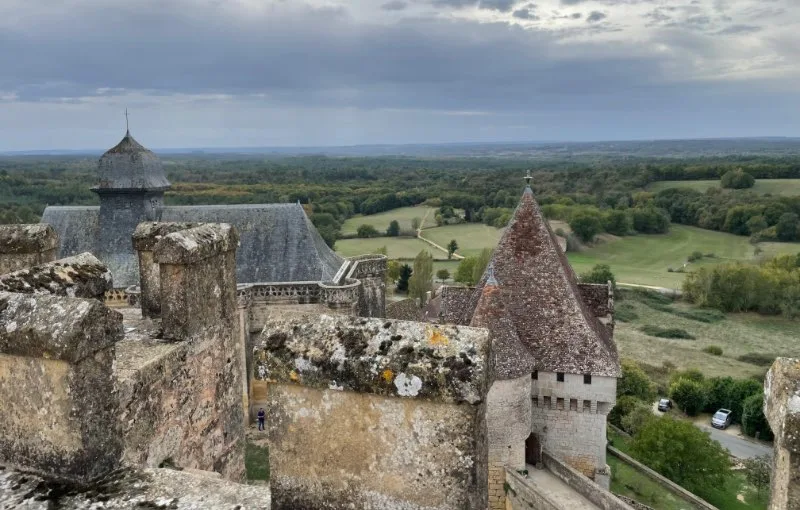
You’re standing in front of a beautiful chateau, wondering what life must have been like centuries ago when people lived here. As you walk through the grand entrance, you start to imagine what it would have been like to be a lord or lady of the manor.
You stroll through the castle, taking in the opulent furnishings and admiring the exquisite details. Each room tells a different story of life in the Middle Ages.
As you leave the castle and walk through the gardens, you can’t help but feel like you’ve stepped back in time. Do consider visiting these three castles of Dordogne. All within driving distance of our holiday home.
Introduction to Three Castles
As you enter the Dordogne region of France, you’ll find an interesting array of castles dotting the landscape. There’s something about these relics of history that makes you feel as though you’re traveling back in time.
Of these, three castles belong to the most popular: Chateau De Biron, Chateau De Beynac and Chateau De Monbazillac. Each one tells a unique story of its own, and all offer stunning views of the surrounding countryside.
Today, these castles are popular tourist destinations, drawing in families from all over the world who want to experience a bit of French history.
A Brief History of these castles
If you’re interested in history, then you’ll love exploring the three castles in Dordogne. All three castles have a rich history, and they share a lot of similarities.
For example, all three castles were used as military fortifications at some point in their history. They also all served as homes for important figures, including kings and lords. And finally, all three castles are located in the Dordogne region of France, which is known for its abundance of castles.
If you’re looking for an informative and educational holiday, then be sure to visit the three castles in Dordogne!
What You Can See and Do
You can explore the history of each of the three castles —Chateau de Biron, Chateau de Beynac and Chateau de Monbazillac— through the eyes of its former residents. There’s something interesting for adults to learn about each castle, and it’s also fun to do for kids.
For example, at Chateau de Biron, you can see the original furniture that was used by the Comtesse de Biron in the 18th century, and you can also explore the different wings of the castle. At Chateau de Beynac, you can walk through the kitchens and see the ovens that were used to cook for up to 500 people at a time. And at chateau de Monbazillac, you can learn about how wine was made in the 18th century and even taste a glass or two.
Interesting Facts
Here are some interesting facts about the three castles:
- Chateau de Biron was built in the 12th century and was originally a fortress. It was later turned into a castle in the 15th century.
- Chateau de Beynac was also built in the 12th century and served as a fortress during the Hundred Years’ War.
- Chateau de Monbazillac was built in the 15th century and is known for its wines.
If you’re interested in learning more about the history of the region, you should definitely visit Chateau de Biron, Chateau de Beynac and Chateau de Monbazillac.
Chateau de Biron has been beautifully restored, and it’s now open to the public as a museum. It’s definitely worth a visit if you want to learn more about the history of the region.
Chateau de Beynac is one of the best-preserved castles in the region, and it’s absolutely stunning. It’s also located in a beautiful setting, overlooking the Dordogne River.
Chateau de Monbazillac is located on top of a hill, and it has breathtaking views of the surrounding countryside. It’s definitely worth a visit if you want to experience the beauty of the Dordogne region.
The history of Chateau de Biron
Chateau de Biron is closed to our holiday home, about a 15 minute drive. So it might be nice to read a bit more about it’s history.
Chateau de Biron is a historic castle located in the Dordogne region of southwestern France. The building dates back to the 11th century and has long been associated with the powerful Gontaut-Biron family. Today it is owned and managed by Committee des Sites et Monuments Historiques, who took over ownership after the chateau was lost in a gamble by the last count, Armand-Louis de Gontaut-Biron in 1795.
The history of Chateau de Biron began in 1020 when Adalbert of Biron built a small castle on the grounds. It was extended by his descendants who gradually expanded it into its current form. The original structure included four towers and an inner courtyard surrounded by fortified walls. Over the centuries, further additions were made to the building including a chapel constructed in 1571, as well as changes to its internal layout such as the addition of grand salons in 1785.
The Gontaut-Biron family had been associated with Chateau de Biron for centuries and reached its peak during the 18th century under Count Armand-Louis de Gontaut-Biron. This infamous individual led an extravagant lifestyle that eventually led to his downfall; he gambled away his inheritance and subsequent efforts to reclaim it failed leading to the sale of Chateau de Biron in 1795. Following this, several owners occupied the residence until it was taken over by Committee des Sites et Monuments Historiques in 1912 who have continued to manage and maintain it ever since.
Today Chateau de Biron remains one of France’s most impressive castles and is home to many fascinating artifacts that tell us more about its history and former occupants. Visitors can explore numerous rooms, including those associated with Count Armand-Louis de Gontaut-Biron, where they can observe luxurious furniture and wall coverings from his era, as well as view collections of paintings that once adorned these walls. In addition, visitors can admire spectacular views from atop one of its towers or take a stroll around its landscaped gardens which feature numerous sculptures dotted around its pathways, providing a picturesque setting for those wishing to explore further than just within castle walls.
FAQs on Visiting the Three Castles
You might be wondering about the best time to visit the three castles in Dordogne. The answer really depends on what you’re looking for.
If you’re interested in seeing the castles in all their glory, then the best time to visit is during the first part of the summer months. This is when the weather is typically warm, the gardens are full in bloom. And weather is not yet on its hottest and driest, so you’ll be able to get the most out of your trip.
However, if you’re interested in avoiding the crowds, then autumn or spring might be a better option for you. Keep in mind that the weather can be a bit unpredictable during these seasons, so make sure to pack accordingly.
No matter when you decide to visit, one thing is for sure – you won’t be disappointed by these incredible castles!
Getting to the castles in Dordogne is pretty easy, as they’re all located within a reasonable driving distance from each other and from our holiday home.
To get to Chateau de Biron, is about a 15 minute drive from our holiday home. Chateau de Beynac is located in the town of Beynac-et-Cazenac, and Chateau de Monbazillac is situated in the town of Bergerac.
Dordogne feels like a step into history
We mentioned it already. When you’re in Dordogne, you can’t help but feel like you’re taking a step back in time. Everywhere you look, there are ancient castles and ruins dotting the landscape. It’s no wonder that this region is sometimes referred to as the “Land of a Thousand Castles.”
So why does Dordogne have so many historical sites? Well, for one, it’s because this region was once an important part of the Roman Empire. In fact, the town of Sarlat-la-Canéda was once the capital of the province of Aquitania.
But it’s not just the Roman Empire that left its mark on Dordogne. This region was also important during the Middle Ages, as it was often fought over by the French and English kings. And because of its strategic location, Dordogne was also home to a number of fortified castles.
Thanks to the three castles in Dordogne, visitors have the rare opportunity to learn the stories of these structures from those who lived through them. Each castle has its own fascinating tale to tell, offering a glimpse into the past that’s sure to leave a lasting impression.
So when you’re visiting Dordogne, you’re not just seeing history—you’re experiencing it. And that’s what makes this region so special.


